Showing posts with label plants. Show all posts
Monday, March 16, 2015
Monday, March 12, 2012
Irises galore
Last fall, after putting a few iris seeds into the fridge for a month, I planted them with the vague idea that about an eighth would come up. This batch would then be transported to Indiana. Sadly, the germination rate was close to a 100% and now we're inundated with baby irises.
On that note, the 5-gallon plastic buckets one gets at Lowe's make excellent and very cheap planters for such run-away projects!
Monday, September 20, 2010
Autumnal reinventory
The trip to the farm was quite enjoyable; a lot of brush-clearing and pasture-mowing was done, along with a little bit of art. Bees are doing well. Three of the hives are almost sure to make it through the winter, two others I'm not so sure aboue.
I brought back both chigger bites and fond memories of hanging out with three very personable mutts; came back to a mostly-alive collection of houseplants, a brand new Kindle, plus a husband that ate too much junk food in the time spent alone. There shall be a lot of reading and gym-going in the nearby future!
I hope to get more organized with blog-posting; maybe keeping it to about a post a week, with book reviews and plant updates included. And speaking of plant updates..
In the realm of AV's, Rob's Loose Noodle's outdone itself with blossoms.

And some of the named leaves I've received in trade have sprouted mouse ears.
Tuesday, April 6, 2010
Trains, lost cows, and wildflowers.
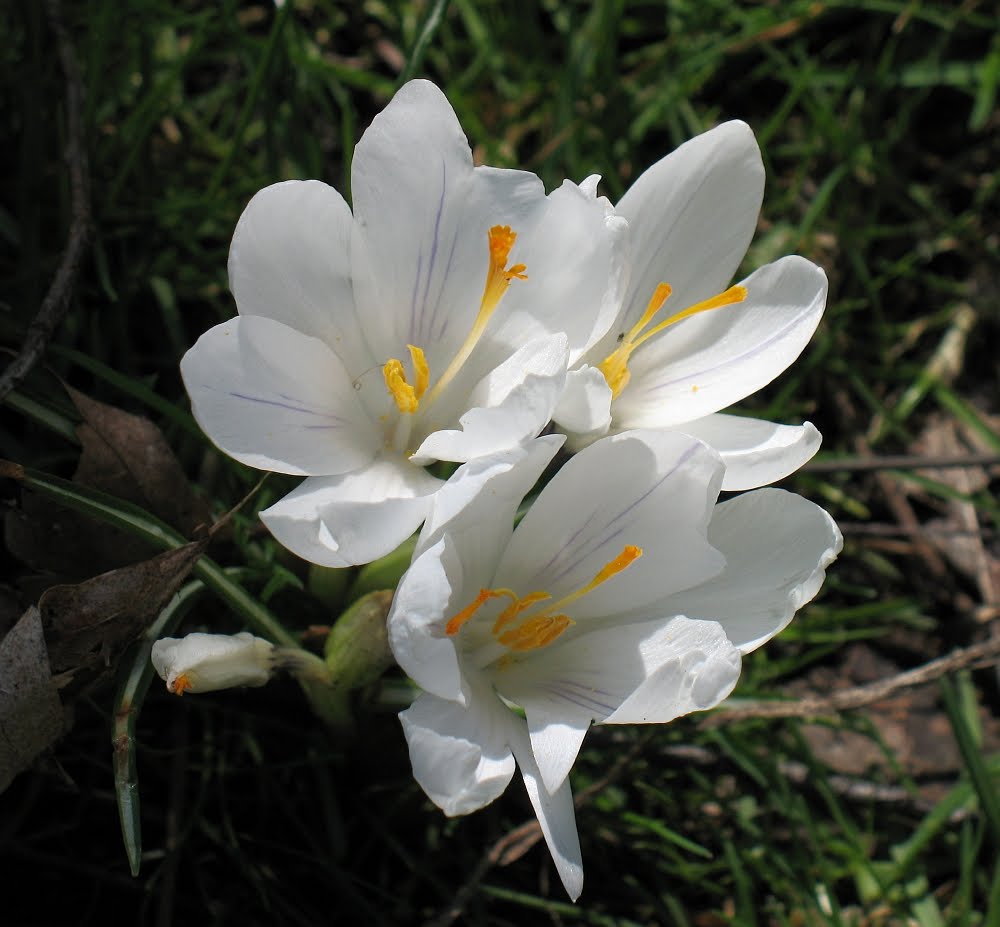
Cherry trees all over Abingdon are bursting into bloom, along with pears and eastern redbuds. The effect is an explosion of pastels, faint and soft-edged, hovering over the streets in a surreal attempt at clouds. Edges of Virginia Creeper trail sprout crocuses.

We haven’t slept well recently, waking up to the bellowing horns of trains, as they speed by this tiny mountain town on their way to somewhere. Trains fascinate me. They symbolize another world, where solid placement in lower class made certain that public transportation was the only feasible way from one place to another. I don’t exactly miss that world anymore than I miss trash on the streets, and human shit in the bushes, and lack of public water fountains. But just because I don’t romanticize it doesn’t mean that it doesn’t hold a certain nostalgia for the old country.
One time last fall, Elrin and I sat on a bench by the Art Depot, just as a massive cargo train roared a mere thirty feet away. We’ve admitted to one another afterwards, that the speedy passage of this machine made us feel a deep unease, a primordial feeling nearing to terror. Very few of its freight wagons were decorated with graffiti, unlike those back home in Champaign. In Illinois, the trains which passed seemed short, painted over and dumpy, disused relics in the world of highways and trucks.
Here, in the mountains, trains remain a force to be reckoned with, roaring down well-maintained railways like some behemoths from the past.
Hiking
El and I have done significant distances on the Creeper Trail, both the stretch starting in Abingdon, and another location closer to Damascus. The latter proved to be a wonderful walk down flower-studded slopes, alongside what I suppose to be Holston river, and one residences too many.

This is a river bank, down which we've traveled some ways before getting back on the trail.

A type of common blue violet, called the confederate violet.

Some spring beauties.

I'm pretty sure that this one's a sharp-lobed hepatica.

Bloodroot is a pretty common spring flower. Its roots can be used for dye of the obvious color.

And a full bloodroot flower! Courtesy of Elrin's steady hand.

This is a corydalis flavula, or yellow fumewart.

Solomon's Seal, Polygonatum commutatum. Both this one and the yellow fumewart were identified by the nice folks at Gardenweb.

We met a calf, which was on the wrong side of the fence..poor terrified bugger.

And a snapshot from the drive back.

Birds
No new bird sightings, surprisingly. Starlings continue to prevail over the surrounding lands, and house finches have increased in number. The resident mockingbird’s been entertaining us in the early mornings with its creative interpretations of other birds. He (or she?) repeats everything two or more times, before moving onto some new sound. Does the bird have a short attention span, or what?
Also, while there aren't any new bird pictures, here's a rather cute spider.

Plants
Here’s a planter update.
Some cucumbers have hatched in the bucket, as of yesterday. Salad greens are coming up, too, though there hasn’t been a sign of scarlet runner beans.
Hyacinths have finished blossoming, only to be replaced by tulips. We've two varieties of those, pure red and pink-with-white-edge.


And the whole planter!
Tuesday, March 2, 2010
No white AVs? I blame you, Mother Nature!
Mother Nature’s gone on her monthlies (centuries’ses?). Earthquakes in Haiti, earthquakes in Chile, one massive, continuous snowstorm over east coast of the US… Dear Mother Nature, please think of the birds. They have to live on this planet too, it’s not just us people. Granted, I don’t see how earthquakes might have an effect on birds, except for maybe disturb their nesting sites. But the thaw->freeze->thaw->freeze->2 inches of snow->thaw->etc cycle isn’t good for wildlife.
Black-capped chickadees are telling this to us by emptying the second feeder of its sunflower seed load in under 4 days. It is possible that chickadees may just be sneaking the seeds off to hide them in cracks of bark (similar to bluejays and woodpeckers at my grandmothers’ feeder in the midwest. She must be going through a pound of nuts a week for those avian thieves.), but I’m going to go out on a limb and blame their resourcefulness on global coo..warming.
Plants

African violets are still in bloom, and I’m afraid that the mystery-violet grown from the leaves gotten through a plant trade will turn out to be solid purple, after all. There goes Errant’s long-standing dream of a mostly-white violet.
While the conjunction of the words “white” and “violet” may seem nonsensical, this is actually far from the case. African Violet (AV) hybridizers have developed literally thousands of varieties, and their work continues around the world (or, at least, in US and Russia. Though when I was growing up in the latter, all –we- had were several pots of solid purple ones, which faded from the scene shortly after a power outage in the middle of the winter).
Colors of AV vary enormously, from trademark purple, to white, green, pink, light blue and red, with yellow making an occasional much-discussed appearance. There is also an AV society of America, which has a website with a good photo library. I’ve long thought of actually going to an AV convention, and there –was- one in Virginia sometime last November, but in the end, the date disappeared under a pile of other concerns and things to do. That’s life, I guess.
http://www.avsa.org/
For me, AVs have been a challenge (though flowers make it all worth it): they’re somewhat finicky in terms of preferred level of light, and it’s very easy to under/overwater them due to the size of their containers. Water on the leaves spots them, and preferred growth medium is what you’d call ‘soilless soil’, aka peat/vermiculite/perilite at a ratio of 1:1:1. This soil ratio is not sold commercially outside spring/sprouting season, so the rest of the year you’re stuck hunting down the ingredients, and mixing the stuff yourself.
For some time, I’ve used this mix for all of my potted plants with exception of cacti, with mixed results. Spider plants absolutely adore it, but need to be kept an eye on, because they do dry easily. Kalanchoes (both mother of millions and chandelier plant) did well, too. Begonia absolutely hated it, and grown-from-seed lemon are still undecided. The dislike on begonia’s part may’ve been due to under-fertilization. I’ve been using a 7-7-7 fertilizer for most all plants, but have now reformed and mixed a batch of 24-8-16 for everything but the violets. With soilless media, you’re the only source of nutrients that the plant has access to, which means that 99% of the time, you’re watering with very diluted plant food.
Birds
Robins continue to stalk the neighborhood, glaring from under cars and behind buildings. A number of hawks has been sighted, majestically gliding above the highway, or balancing precariously on telephone wires. Outside our windows, song and white-crowned* sparrows seem content to raid feeders and start up ungodly cacophony of “I’m hawt!” and “Your place, or mine!?” sort earlier and earlier every morning.
There was (what I suspect is) an eastern phoebe in the back yard a few days back.. identifying a new specie is refreshing, to say the least.

*I’ve yet to determine if these are white-crowned or white-throated. The birds definitely have the white throat, but not the yellow spot that would identify them as white-throated. Will try to get a better look and/or a picture this week.
Subscribe to:
Posts (Atom)